

Paper 1
120 minutes
No calculator
Compulsory short- and extended-response questions with an emphasis on analytical methods, clear working and mathematical reasoning.
IB MATH AA HL · YEAR 5 & YEAR 6
Tim Gan Math offers IB Mathematics: Analysis and Approaches Higher Level (AA HL) tuition for Year 5 and Year 6 students in Singapore. Learn with Mr Gan at Bukit Timah or join online, with structured notes, IB practice and TGM Study Hub access.
From S$110per two-hour lesson · Paid by term · Bukit Timah & online
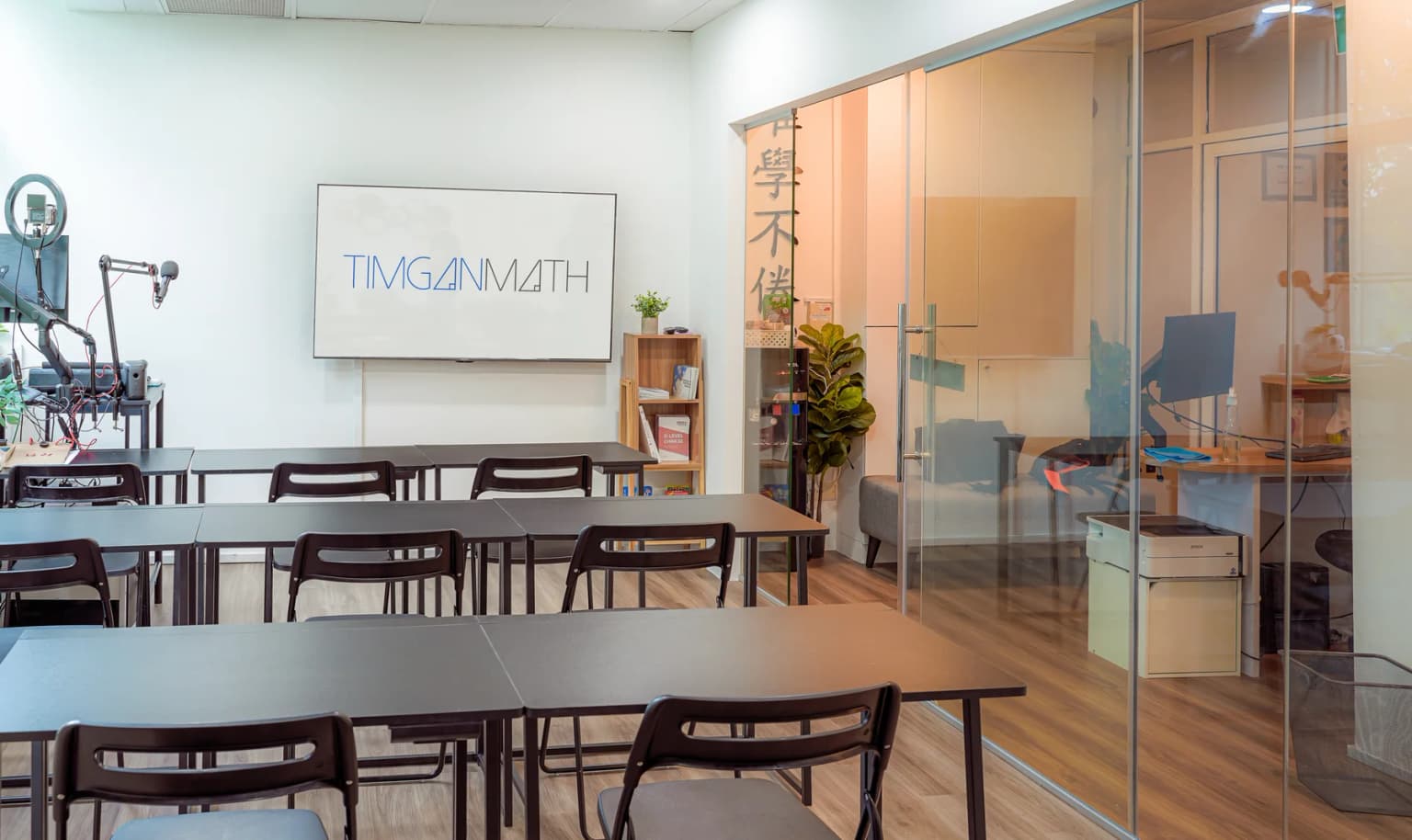 Two hours to work it through
 Learning continues after class
A clearer path
through AA HL.
A WEEK AT TIM GAN MATH
AA HL asks you to connect ideas and explain your reasoning. Our programme links your weekly lesson to the practice, explanations and support you need between classes.
01 / YOUR WEEKLY LESSON
The move from Year 4 or IGCSE into AA HL can feel steep. Mr Gan starts with the underlying concepts, works through examples and helps you put the method into practice.

YOUR AA HL TOPIC MAP
Concept → worked example → independent practice
02 / FROM CLASS TO YOUR DESK
Structured notes connect each new concept to worked examples and practice. Revisit the reasoning after class, then use the AA HL syllabus outline to see how the topics fit together.
03 / PRACTISE. REVIEW. UNDERSTAND.
Use the IB Mathematics question bank to practise a topic, check your approach and work through the steps that need another look. Video explanations and handwritten solutions help make revision more deliberate.

04 / SUPPORT BETWEEN LESSONS
TGM Study Hub brings recorded lessons, handwritten solutions and worksheets together. Review at your own pace, then ask through WhatsApp or the online community when you need more guidance.
Study Hub resources are available while enrolled in the programme.
Meet your tutorYOUR IB MATH TUTOR
Mr Gan teaches both Year 5 and Year 6 AA HL classes. His approach begins with clear explanations and strong conceptual foundations, followed by practice that builds in difficulty.
 Mr GanIB Mathematics AA HL · Year 5 & Year 6
THE BIG PICTURE
Five topic areas, from Number & Algebra to Calculus. Explore the full outline and assessment structure for 2026 examination sessions.
120 minutes
No calculator
Compulsory short- and extended-response questions with an emphasis on analytical methods, clear working and mathematical reasoning.
120 minutes
Graphic display calculator required
Compulsory short- and extended-response questions. A GDC is required, although not every part needs technology.
60 minutes
Graphic display calculator required
Two compulsory extended-response problem-solving questions that assess sustained reasoning across the syllabus.
Individual exploration
Technology used where appropriate
A mathematical exploration in which students investigate a chosen topic and communicate their mathematics clearly.
SL content is the shared foundation; AHL marks the additional Higher Level content. Hours shown are the syllabus teaching hours.
1.1 SL
1.2 SL
1.3 SL
1.4 SL
1.5 SL
1.6 SL
1.7 SL
1.8 SL
1.9 SL
1.10 AHL
1.11 AHL
1.12 AHL
1.13 AHL
1.14 AHL
1.15 AHL
1.16 AHL
Exam focusStudents commonly lose marks through imprecise algebra, missing restrictions and incomplete proof structure.
2.1 SL
2.2 SL
2.3 SL
2.4 SL
2.5 SL
2.6 SL
2.7 SL
2.8 SL
2.9 SL
2.10 SL
2.11 SL
2.12 AHL
2.13 AHL
2.14 AHL
2.15 AHL
2.16 AHL
Exam focusStudents need to connect algebraic, graphical and technological approaches while respecting domains and ranges.
3.1 SL
3.2 SL
3.3 SL
3.4 SL
3.5 SL
3.6 SL
3.7 SL
3.8 SL
3.9 SL
3.10 AHL
3.11 AHL
3.12 AHL
3.13 AHL
3.14 AHL
3.15 AHL
3.16 AHL
3.17 AHL
3.18 AHL
Exam focusDiagrams, exact values, valid solution intervals and the geometry behind vector equations must be communicated precisely.
4.1 SL
4.2 SL
4.3 SL
4.4 SL
4.5 SL
4.6 SL
4.7 SL
4.8 SL
4.9 SL
4.10 SL
4.11 SL
4.12 SL
4.13 AHL
4.14 AHL
Exam focusStudents must distinguish association from causation, choose valid models and interpret calculator output in context.
5.1 SL
5.2 SL
5.3 SL
5.4 SL
5.5 SL
5.6 SL
5.7 SL
5.8 SL
5.9 SL
5.10 SL
5.11 SL
5.12 AHL
5.13 AHL
5.14 AHL
5.15 AHL
5.16 AHL
5.17 AHL
5.18 AHL
5.19 AHL
Exam focusMethod marks depend on showing the correct calculus setup, interpreting results and justifying endpoints, extrema and constants.
Schools may teach the same content in different sequences. This outline follows the IB guide for 2026 examinations; the official guide remains the source for assessment requirements. Read the official IB guide (opens in a new tab)
ONE CONNECTED PROGRAMME
Weekly teaching, structured materials and support between lessons, with clear fees for each year group.
At Tim Gan Math, we believe in honest, transparent pricing.
Term-based payments only – no hidden fees or surprise add-ons.
What you see is what you pay – regular lessons and materials are included.
Price Protection Guarantee – join in Year 5, keep the same rate through Year 6
Join a trial lesson – find out whether our teaching style suits your learning needs.
IB MATHEMATICS AA HL
Build your AA HL foundations.
S$110per two-hour lesson · paid by term
Join in Year 5 and keep the S$110 lesson rate through the end of Year 6.
| Term & dates | Lessons | Fee (S$) |
|---|---|---|
| Term 126 Jan – 5 Apr | 9 | 990 |
| Term 26 Apr – 27 Jun | 12 | 1,320 |
| Term 328 Jun – 12 Sep | 11 | 1,210 |
| Term 413 Sep – 30 Nov | 11 | 1,210 |
IB MATHEMATICS AA HL
Consolidate and prepare for the next exam.
S$120per two-hour lesson · paid by term
For students joining in Year 6. Year 6 classes start in November of Year 5.
| Term & dates | Lessons | Fee (S$) |
|---|---|---|
| Term 12 Jan – 5 Apr | 12 | 1,440 |
| Term 26 Apr – 27 Jun | 12 | 1,440 |
| Term 328 Jun – 12 Sep | 11 | 1,320 |
| Term 413 Sep – 10 Nov | 11 | 1,320 |
We only accept term payment. Fees are fixed from Year 5 to Year 6 (if you join in Year 5, fees remain at $110/lesson until end of Year 6). Year 6 starts in November.
TRY A LESSON WITH MR GAN
Choose your year group and preferred class. We will contact you to confirm availability and arrange your paid IB Math AA HL trial lesson.
Bukit Timah (King’s Arcade), near Tan Kah Kee MRT. Online attendance is also available.
King's Arcade, 559 Bukit Timah Rd, #03-01B, Singapore 269695
5 mins walk from Tan Kah Kee MRT
View Centre DetailsGet DirectionsYOUR NEXT CHAPTER
Meet Mr Gan, experience an AA HL lesson and see how the programme fits your learning needs.
Book a Trial Lesson Trial lessons are paid sessions.Experiences from Year 5 and Year 6 AA HL students
“Mr Gan's lessons have helped me to improve from scoring 50s to 80s in my math exams within the span of only a few months. He tailors his lessons according to the weaknesses and strengths of his students, and makes sure that his students understand the content being taught. Lessons with him are flexible and interesting, and he teaches in a way that is easy to comprehend. All in all, I had a great experience learning from Mr Gan and I am thankful for his dedication and commitment in helping me improve as a student.”
Marcus Chao
ACS (Independent)
“When I first came into the class, I disliked the subject Mathematics greatly, every time I came across it, I would try to avoid it. Initially, I was doing very badly in school for Mathematics and often failing the subject. However, after I joined Mr Gan's class, I found my interest for the subject to deepen and my grades have slowly improved as well. Mr Gan's classes are always fun and interesting and he never fails to make us laugh whilst still managing to help us in clarifying our doubts. It is amazing how much he can accomplish in these lessons despite me not having a strong mathematical foundation and not paying attention in school. I am very grateful for Mr Gan and is definitely a great teacher.”
Keat Wee
ACS (International)
“Mr Gan saved me from dreadful Math. He never failed to make math enjoyable as his explanations always make the concepts very clear and easy to comprehend. He is always super patient with my quarries (because I am super blurh sorry sir) and never failed to answer our questions. His notes were extremely clear cut for revision and even when first introduced to the concepts. Mr Gan always prepares material based on topics that we are unclear with beforehand to ensure that lessons are super-efficient but yet extremely fun that you don't even realise that you did 2 hours of lessons. It extremely productive and I am super grateful for the past years with Mr Gan. Thank you so much for the lessons and helping me improve my math!”
Ruth Rachael Mathew
ACS (International)
A few things to know before joining our Year 5 and Year 6 AA HL classes.
Year 5 IB Math AA HL tuition costs S$110 per two-hour lesson. Students joining in Year 6 pay S$120 per two-hour lesson. Fees are paid by term. Students who join in Year 5 keep the S$110 lesson rate through the end of Year 6. Lesson notes, the IB question bank, TGM Study Hub access and WhatsApp consultation are included while enrolled. Trial lessons are paid sessions.
These classes are for IB Mathematics: Analysis and Approaches Higher Level (AA HL), in Year 5 and Year 6 of the Diploma Programme. AA SL and Mathematics: Applications and Interpretation (AI) are different courses. If you take AA SL, AI SL or AI HL, contact us to discuss suitability before booking an AA HL trial.
Yes. Both Year 5 and Year 6 IB Math AA HL classes offer online attendance with Mr Gan. Students can also attend in person at King's Arcade in Bukit Timah, near Tan Kah Kee MRT. TGM Study Hub provides lesson recordings, handwritten solutions and worksheets for revision while enrolled. Check the timetable and contact us to confirm availability.
Choose your year group and preferred class in the trial lesson form on this page. We will contact you to confirm availability and arrange your IB Math AA HL trial with Mr Gan. Trial lessons are paid sessions; confirm the trial fee and class details with us before attending.
IB Mathematics is part of the International Baccalaureate Diploma Programme (IBDP) offered to students in Years 5-6. We teach IB Mathematics AA HL (Analysis & Approaches, Higher Level) for Year 5 and Year 6 students. The programme covers all five core topics: Number & Algebra, Functions, Geometry & Trigonometry, Statistics & Probability, and Calculus. We focus on building strong foundations from IGCSE, addressing the challenging gap between Year 4 and Year 5 content, and preparing students for IB examinations.
The transition from Year 4 (typically IGCSE) to Year 5 (IB Diploma) represents one of the most challenging academic jumps students face. IB Mathematics HL introduces significantly more complex concepts, faster pacing, and higher expectations for independent learning and mathematical reasoning. Our programme specifically addresses this gap by building naturally on IGCSE Mathematics foundations while introducing IB-level rigor systematically. We focus on not just academic success, but helping students enjoy the learning process and apply concepts to future careers.
While not absolutely necessary, IB Math tuition significantly helps students navigate the challenging International Baccalaureate Diploma Programme (IBDP). The jump from Year 4 to Year 5 is substantial, and IB Mathematics AA HL (Analysis & Approaches) requires deep conceptual understanding, strong problem-solving skills, and consistent practice. Our tuition provides structured curriculum designed by IB teachers, hundreds of practice questions with video solutions, comprehensive lesson notes, and WhatsApp consultation support. Students from ACS (Independent), SJI, and UWCSEA have benefited from our comprehensive approach to mastering IB Math concepts and building confidence for examinations.
In 2027, IB Math AA HL classes are held at Bukit Timah (King's Arcade, near Tan Kah Kee MRT) and taught by Mr Gan. Year 5 has three options: Wednesday or Thursday 3:00 PM - 5:00 PM, or Friday 7:15 PM - 9:15 PM. Year 6 runs on Friday 5:00 PM - 7:00 PM. Every class can be attended in-centre or by livestream. Please contact us to check the latest availability.
Our IB Mathematics AA HL (Analysis & Approaches) curriculum is meticulously designed by experienced IB teachers and university professors, following the current IB syllabus requirements. It covers all five core topics: Number & Algebra, Functions, Geometry & Trigonometry, Statistics & Probability, and Calculus. The curriculum builds naturally on IGCSE Mathematics foundations and specifically addresses the challenging gap between Year 4 and Year 5. We emphasize conceptual understanding, problem-solving skills, and real-world applications. The programme includes regular assessments, practice exams, and continuous feedback.
The TGM Study Hub is your '24/7 Educational Netflix' for IB Math. You get full access to video recordings of all lessons, handwritten solutions to past materials, and additional worksheets—available anytime, anywhere while you're enrolled. The TGM Study Hub covers every IB Math topic taught in class, allowing you to review missed lessons, reinforce concepts at your own pace, and prepare for exams with comprehensive resources. It's designed for self-paced learning that builds mastery and confidence beyond classroom hours.
Our IB Mathematics Question Bank contains hundreds of carefully curated IB exam-style questions with comprehensive solutions. Every question comes with both video and handwritten explanations, making it easy to understand complex concepts and exam techniques. The question bank accompanies the TGM Study Hub and is organized by topics for focused practice. This extensive resource helps build exam confidence through unlimited practice opportunities and exposure to various question types that appear in IB examinations.
The current IB Math Year 5 and Year 6 classes are taught by Mr Gan, founder of Tim Gan Math and an ex-MOE teacher with 18 years of mathematics teaching experience across O-Level, A-Level, and IB HL Mathematics. His lessons focus on clear conceptual foundations, rigorous practice, and exam-ready problem-solving so students can apply IB Math concepts confidently under pressure. Please contact us for the latest availability details.
We provide comprehensive support beyond classroom hours through WhatsApp consultation with instructors, active online community support, and regular feedback sessions. You can ask questions, clarify doubts, and receive timely help from our tutors whenever you need it. Whether you prefer face-to-face discussion (before/after class) or digital support (WhatsApp/online community), our support system ensures learning doesn't stop after class. You'll also connect with fellow IB students facing similar challenges for peer learning.
IB Mathematics AA HL (Analysis & Approaches) and A-Level H2 Math are both rigorous pre-university mathematics programmes, but they differ in structure and approach. IB Math AA HL emphasizes international perspectives, real-world applications, and mathematical inquiry. It includes an Internal Assessment (IA) component requiring independent research and covers topics like complex numbers and differential equations. A-Level H2 Math focuses more on pure mathematical techniques and exam-focused problem-solving. Both require strong foundational skills, but IB places additional emphasis on mathematical communication, exploration, and connecting mathematics to global contexts.
Book a trial class to speak with our tutors directly and get all your questions answered.