

A summary booklet should help a student see the structure of H2 Mathematics. It should not become a set of training wheels that stays open beside every practice question.
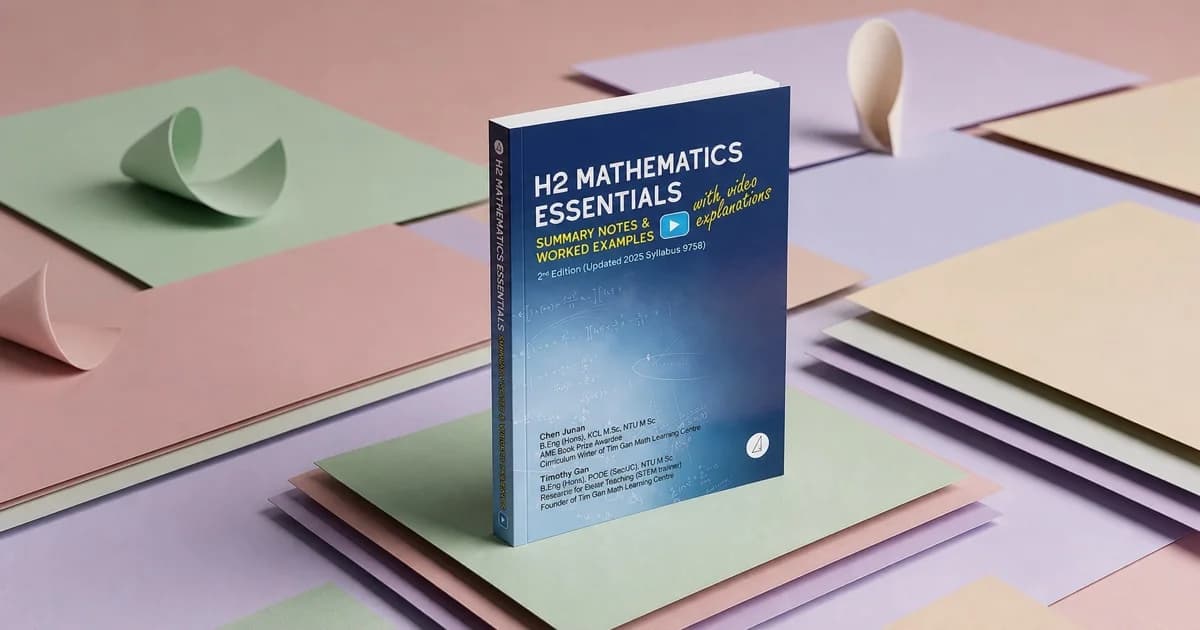
The H2 Mathematics Essentials, Second Edition, published in 2024, condenses the current H2 Mathematics syllabus into approximately 150 pages of summary notes, formulas, critical worked examples and selected practice questions with video solutions. Its strongest advantage is the connection between the printed book and the TGM Study Hub.
This guide explains what the booklet is for, what it cannot replace and how JC1 and JC2 students can use it without becoming dependent on notes.
H2 Mathematics Essentials, Second Edition was published in 2024 and contains approximately 150 pages covering the current H2 Math syllabus.
It combines concise summaries, formulas, critical worked examples, selected practice and connected video solutions.
JC1 students can use it to understand a new topic; JC2 students can use it to rebuild weak foundations before returning to exam questions.
The booklet is a reference and springboard—not a replacement for tutorials, TYS questions, timed papers or full examination practice.
Annotate genuine gaps and recurring errors, then close the booklet and reattempt the question independently.
What Is Inside H2 Mathematics Essentials?
The booklet covers the topics in the current H2 Mathematics syllabus and includes:
- Concise topic summaries
- Important formulas and definitions
- Critical worked examples that establish the main methods
- Selected practice questions
- Video solutions accessed through the connected online system
The current edition does not claim to catalogue every common mistake, nor does it provide enough questions for complete examination preparation. A future rewrite may expand those elements. The present booklet is best treated as an organised overview and reference, not a full question bank.
The Main Advantage: Print Connected to an Online System
Ordinary notes end on the page. H2 Mathematics Essentials connects the printed explanation with the TGM Study Hub, where students can review video-supported material and access additional resources.
This matters when a student understands most of a method but cannot see why one step follows from another. Instead of searching randomly for a similar answer, the student can use a relevant worked explanation and compare the reasoning with their own attempt. The technology supports the learning process; it does not replace the student's thinking.
What the Booklet Should Not Replace
The booklet is not designed to replace:
- School tutorials and assignments
- Sustained topical practice
- Timed papers
- Ten-Year Series questions
- Full prelim and A-Level examination practice
- Feedback from a teacher or tutor when a misconception persists
The selected questions help students begin applying a concept, but they are not sufficient preparation on their own. Students still need to encounter unfamiliar forms, combine topics and complete full solutions under time pressure.
How JC1 Students Should Use It
For JC1 students, the booklet works best as a springboard into a topic:
- Read the summary to understand the topic's overall structure.
- Study the critical worked examples.
- Close the booklet and attempt the selected questions.
- Annotate definitions or steps that were initially unclear.
- Move on to school tutorials and a larger set of practice questions.
Students should resist keeping the booklet open throughout practice. If every method is copied from the page, the work tests recognition rather than recall or problem-solving.
How JC2 Students Should Use It
During prelim and A-Level revision, JC2 students can use the booklet to rebuild the basic logic of a weak topic before returning to examination questions.
A useful sequence is:
- Attempt the question or paper without notes.
- If stuck, identify whether the gap is a formula, a concept or the interpretation of the question.
- Refer to the relevant summary or worked example only for that gap.
- Close the booklet and complete the solution independently.
- Reattempt the question later without help.
This is consistent with our guide on how to use H2 Math notes without getting stuck.
Annotate the Booklet—but Make the Notes Earn Their Place
Students are encouraged to write in the booklet. Useful annotations include:
- A missing algebraic step that caused confusion
- A condition for using a result
- A recurring error from a test paper
- A link between two topics
- A reminder that a formula is or is not supplied in MF27
Avoid turning every margin into a copied solution. The most valuable note is usually the one created after a genuine error or question. Some successful students also use the booklet as a foundation, then create a shorter personal set of notes based on their own weaknesses.
How to Combine the Booklet, MF27 and the Question Bank
Each resource has a different job:
| Resource | Best use |
|---|---|
| Summary booklet | Rebuild the topic overview and review critical examples |
| MF27 | Check results supplied in the examination and learn where they appear |
| School tutorials/TYS/papers | Practise recall, application and exam presentation |
| TGM Question Bank | Find targeted questions and use video explanations when a method remains unclear |
During ordinary practice, keep MF27 available because it is the official reference supplied in the examination. Keep the summary booklet closed unless the attempt reveals a real gap. The Question Bank's search tools can help locate a question or explanation related to that gap.
Studying in the Age of AI
Search and AI tools can shorten the time needed to locate an explanation, but they can also remove the productive struggle that builds mathematical independence. The safest workflow is attempt first, search second, study the explanation, then reattempt without assistance.
Our article How to Study Math in the Age of AI explains how students can combine Photo Search, a structured Question Bank, written solutions and videos without outsourcing the thinking.
What Students Say About the Notes and Online Resources
Individual reviews do not guarantee a result, but they illustrate how students have used the system. Chia Shan Hua described receiving exercise booklets, a summary booklet and access to the student platform, and reported achieving an A at A-Levels. Darrius Yap highlighted notes organised by question type together with extra questions and video solutions. Snikitha Guddati described the Study Hub videos as helpful because they explain important details and concepts within each question.
These are individual experiences. Outcomes depend on a student's starting point, practice and use of the resources. Read the original accounts on our testimonials page.
Conclusion
H2 Mathematics Essentials is a compact map of the syllabus and a bridge to video-supported explanations. It is most useful when students consult it for a specific gap, annotate what they learn and then return to independent practice.
Action Steps:
Use the booklet to understand the topic structure
Close it before attempting questions
Annotate genuine gaps and recurring errors
Use MF27 as the examination reference
Use the Question Bank when a worked explanation is needed
Return to timed papers and full exam practice
Purchase the H2 Mathematics Essentials, Second Edition or preview the current sample pages below. Students who need more practice can also explore the TGM Math Question Bank.