

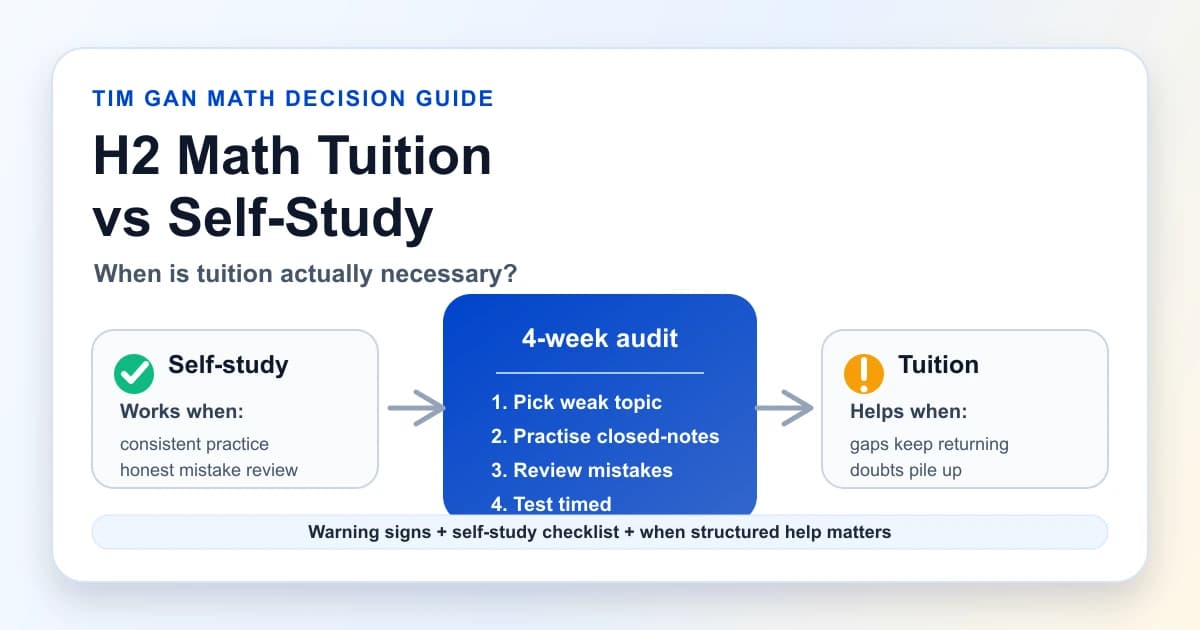
H2 Math tuition is not automatically necessary for every JC student.
Some students can self-study H2 Mathematics very well. They can plan their week around school and CCA, protect their attention from constant phone use, practise consistently, mark their work honestly, and ask for help before small doubts become large gaps. For them, tuition may be optional. But for another group, self-study becomes a loop of rereading notes, getting stuck at the same question types, and losing confidence each time a school test arrives.
This guide gives a balanced way to decide. Instead of asking, "Is H2 Math tuition good?", ask the more useful question: "Is my current system producing progress - and if it is not, what support is actually missing?"
You do not need H2 Math tuition if you can keep pace with school, protect focused study time, diagnose mistakes, practise independently, and improve across tests.
Tuition becomes useful when you are putting in serious effort but getting little output because the practice is not targeted or gaps are not being diagnosed.
Self-study fails when students only reread notes, avoid hard questions, or cannot tell whether a mistake is careless or conceptual.
Good tuition should offer more than a two-hour lesson: a system for targeted practice, feedback, question exposure, exams, and timely doubt clarification.
Do not choose tuition out of panic. Use a four-week self-study audit first, then decide based on evidence.
The Balanced Answer: Tuition Is a Tool, Not a Badge
There is no honour in struggling alone if the struggle is not productive. There is also no magic in attending tuition if the student does not practise, review mistakes, or ask questions.
The real question is not whether H2 Math tuition is "necessary" in a general sense. The better question is whether your current learning system is producing progress. Practice matters, but correct practice matters too.
A strong self-study system has five parts:
- You understand the lesson well enough to start tutorial questions.
- You can protect a focused block of time instead of repeatedly breaking it with your phone or other distractions.
- You attempt questions before reading full solutions.
- You can classify mistakes as careless, conceptual, or exam-technique related.
- You have a way to clarify doubts quickly, and your test results or question accuracy improve over time.
If those parts are working, tuition may not be urgent. If several are missing, extra support may save time and prevent gaps from compounding.
When Self-Study Is Enough for H2 Math
Self-study can work very well for students who are disciplined and honest with feedback. At JC level, most students understand what self-study means. The differentiator is whether they can compartmentalise: plan around school and CCA, protect attention, and still carry out the plan when nobody is chasing them. In fact, tuition should never replace independent learning. Even students in a strong tuition programme still need to practise outside class.
Self-study is probably enough if you can say yes to most of these:
- I can follow most school lectures and tutorials without being lost for days.
- I can make and keep a realistic weekly study plan alongside CCA and other commitments.
- I can put my phone away long enough to complete a proper question-practice block.
- I can start questions without keeping my notes open beside me.
- I use MF27 properly instead of memorising blindly.
- I complete enough questions each week, not just before tests.
- I review worked solutions actively and know which line changed my thinking.
- I know how to use school consultations, teachers, friends, or reliable resources when I am stuck.
- I can see measurable improvement across timed practice or school assessments.
Self-discipline alone is not the whole story. Good school notes, a clear tutorial sequence, and accessible doubt-clearing are part of the support system too. For students whose system is working, the best investment may be better resources rather than weekly tuition: a clear H2 Math summary booklet, a reliable H2 Math question bank, or a structured online portal with video explanations.
Warning Signs That H2 Math Tuition May Be Necessary
Tuition becomes more important when self-study is no longer giving useful feedback. The clearest pattern is not simply, "I am working hard." It is, "I have put in a lot of time, but I am getting very little output." That usually means the student needs help finding the correct practice, not merely more practice. These are the warning signs I would take seriously.
1. You Are Working Hard but Getting Little Output
Some students spend a long time on questions and genuinely try, yet their accuracy, speed, or confidence barely moves. This is not always a laziness problem. It can mean they are repeating the wrong type of practice, using an inefficient method, or missing a small idea that blocks an entire question family.
A school teacher, a capable friend, or a tutor may be able to spot the issue. The key is to get a specific diagnosis: what exactly am I doing wrong, and which questions should I practise next?
2. Your Weak A Math Foundation Is Snowballing
Many H2 Math problems begin before JC. Weakness in O-Level A Math topics such as trigonometry, surds, logarithms, algebraic manipulation, and graphing can make H2 Math feel much steeper.
If every new H2 topic also exposes an old secondary-school gap, self-study becomes slower because you are not just learning the current topic - you are repairing the foundation underneath it. This is when structured help can shorten the recovery process.
3. You Keep Rereading Notes but Cannot Start Questions
This is one of the clearest signs. Students often believe, "I need to finish the notes before I practise." But for H2 Math, practice is where the concept becomes usable.
If you keep rewriting notes, copying formulas, or watching solutions without attempting questions, read our guide on how to use H2 Math notes without getting stuck. If you still cannot move from notes to questions, tuition may help by forcing the right sequence: concept, attempt, feedback, repair.
4. The Same Topics Keep Hurting Your Score
Some topics are notorious because they test recognition, not memorisation. Vectors can look like many formulas, but it usually comes down to a few core ideas: dot product, cross product, line and plane equations, projection, perpendicularity, and geometry interpretation.
Statistics topics such as Permutations and Combinations, Probability, and Hypothesis Testing also punish students who only memorise templates. If the same topic keeps returning as a weak area after multiple rounds of self-study, you probably need better diagnosis, not more passive reading.
5. You Cannot Tell Whether Mistakes Are Careless or Conceptual
Careless mistakes can be minimised. Conceptual mistakes must be eradicated. The problem is that many students treat both the same way: they mark the answer wrong, copy the solution, and move on.
If you do not know why you lost marks, your next practice session becomes random. Our guide to common mistakes in A-Level H2 Math explains why mistake review matters. A good tutor should help you identify the real cause of the error, not only show the correct answer.
6. Doubts Pile Up Faster Than You Can Clear Them
One unresolved doubt is manageable. Three connected doubts can become a topic-wide gap. This is especially common when students wait until the next school consultation, the next tuition lesson, or the next exam to ask for help.
If your questions keep piling up, look for support that includes fast doubt clarification, such as WhatsApp consultation or video solutions. The goal is not dependency; the goal is to keep momentum.
A Four-Week Self-Study Audit Before You Decide
Before committing to tuition, give self-study a fair test. Four weeks is enough to see whether the problem is focus, resources, incorrect practice, or deeper conceptual confusion. This is not a test of whether you can suffer alone; it is a way to collect evidence about what support you actually need.
The Four-Week Tuition Decision Audit
Use evidence, not panic, to decide whether H2 Math tuition is actually necessary. The goal is correct practice, not simply more hours spent.
- Week 1
Pick two weak subtopics
Choose specific areas, not broad chapters. For example: vector projection, integration by parts, or P&C arrangements with restrictions. Put a realistic, phone-free practice block in your weekly plan.
- Week 2
Practise with notes closed
Use MF27 only where appropriate. Attempt questions before looking at worked solutions, then use similar questions to test whether the method transfers. Use similar H2 Math questions.
- Week 3
Review mistakes honestly
Classify each error as careless, conceptual, exam technique, or GC/calculator workflow. For conceptual errors, write down the exact idea that was missing and practise a related question.
- Week 4
Test under timed conditions
Attempt a short set without help. Compare accuracy, starting confidence, and speed against Week 1.
- Decide
Choose the next support level
If accuracy and confidence improved, continue self-study. If effort stayed high but the same gaps remain, seek structured guidance that can diagnose the problem.
The point is not to prove that tuition is good or bad. The point is to find the support level and process that moves you forward.
What Good H2 Math Tuition Should Actually Do
Good tuition is not just more homework. If tuition only gives you another stack of worksheets, it may not solve the real problem. A two-hour weekly lesson, by itself, does not make a student better at H2 Math. Listening to a tutor explain a question is different from being able to start it alone under exam conditions.
A strong H2 Math tuition programme should help with:
- Diagnosis: finding exactly where the concept or method breaks, especially when effort is high but output is low.
- Sequencing: choosing practice questions in the right order, from accessible to exam-style, so students learn the correct practice.
- Feedback: correcting misconceptions before they become habits, with worked and handwritten solutions where useful.
- Question exposure: showing how A-Level questions disguise a small number of core concepts.
- GC skills: building fluency with graphing calculator workflows.
- Doubt clarification: answering questions before gaps snowball.
- Assessment: using marked scripts and exam conditions to show how the student is performing, not only how they feel.
- Confidence: setting achievable goals so students can see progress.
A good H2 Math tutor also has a wider view across JC systems: different schools sequence topics differently, set different internal examinations, and provide different support. That perspective can help a student understand what to prioritise without blaming the school or the student. Students can also refer to the official 2026 SEAB H2 Mathematics syllabus for the examination framework they are preparing for.
At Tim Gan Math, this is why the H2 Math tuition programme is built around live lessons, a structured curriculum, internal assessments, a question bank with similar-question suggestions, worked video solutions, handwritten solutions, and consultation support. But the principle applies generally: choose a process that helps the student become more independent over time, not more dependent.
What Tuition Cannot Replace
This part matters. Tuition cannot replace personal effort.
A tutor can explain a concept clearly, but the student still has to attempt the question. A question bank can provide similar questions, but the student still has to work through variations. Video solutions can clarify a method, but the student still has to pause and ask, "Which clue should I have noticed?"
Tuition also cannot remove every careless mistake. Even very strong students make occasional slips. What tuition can do is help students build checking routines, calculator fluency, and better awareness of recurring mistakes.
So do not treat H2 Math tuition as a silver bullet. If a student is not willing to practise, review, and ask questions, two hours of tuition a week will not be fully effective. The best results happen when tuition and self-study support each other.
A Real Student Pattern: An A in H2 Math Without O-Level A Math
One student I taught had not taken O-Level Additional Mathematics and came from a JC where she felt she had less of a head start. It would have been easy to conclude that an A in H2 Math was out of reach. It was not.
She put in an enormous amount of effort and worked systematically through the materials, questions, feedback, and support available to her. By the A-Level examinations, she achieved an A for H2 Math.
This is not a promise that every student will follow the same timeline. It is evidence that not taking A Math, or not coming from the most academically competitive school, is not a death sentence. The important part is the process: identify gaps, use the right materials, practise deliberately, get feedback, and keep going. You can read more student experiences on our testimonials page.
Tuition vs Self-Study: A Practical Decision Table
| Situation | Self-study may be enough if... | Tuition may help if... |
|---|---|---|
| Concept learning | You can understand school explanations and start questions after reviewing notes. | You need concepts explained in another way before questions make sense. |
| Focus and planning | You can plan around school and CCA, protect focus, and follow through without reminders. | Phone use or poor structure keeps breaking practice sessions, even when you intend to work. |
| Practice quality | Your chosen questions address a clear weakness and your accuracy improves. | You are spending many hours but making little progress or repeating the same question type wrongly. |
| Mistake review | You can identify whether errors are careless, conceptual, or exam-technique related. | You copy solutions but repeat the same mistakes next week. |
| Doubt clearing | You know how to get timely help from teachers, friends, or reliable resources. | Doubts pile up and block later topics. |
| Exam readiness | Timed practice shows improving accuracy, speed, and confidence. | You need marked work and exam-condition feedback to know where you stand. |
Use the table as a decision tool. If you are mostly in the self-study column, keep going and strengthen your resources. If you are mostly in the tuition column, do not wait until confidence collapses.
How Parents and Students Should Decide Without Panic
Tuition is a meaningful decision: it takes time, money, travel, and emotional energy. Make it calmly. First, make sure the student knows how to use existing school support. Sometimes a school teacher, consultation slot, classmate, or better use of the notes is enough.
Sometimes the issue is neither the school nor the student. Different JCs have different pacing, systems, and assessment calendars, and students may need a structure that fits them better. Tuition gives families a choice of teacher and process, but it should be chosen for that fit, not as an automatic upgrade.
Before choosing a centre or tutor, ask:
- What exact problem are we trying to solve: focus, content, practice quality, confidence, or exam performance?
- Is the student putting in effort but getting little output?
- Has self-study been tested properly for four focused weeks?
- Does the tutor explain how they diagnose gaps and select the next questions?
- Are there resources beyond the weekly lesson, such as video solutions, marked work, internal assessments, or a question bank?
- Can the student ask doubts outside class before they pile up?
- Does the trial lesson show a clear teaching style and learning fit?
If you decide that tuition is needed, read our guide on how to choose the best H2 Math tutor in Singapore. The right fit and process matter more than simply joining the nearest class.
Conclusion
H2 Math tuition is useful when the student's current learning system is not producing progress. It is not necessary merely because everyone else has tuition, and it only works when paired with real practice.
Action Steps:
Run the four-week self-study audit before deciding, with focused and phone-free practice blocks.
Track two weak subtopics and measure whether accuracy improves.
Use notes properly: learn one concept, then practise with notes closed.
Review mistakes as careless, conceptual, exam-technique, or calculator workflow errors.
If the same gaps remain, consider structured H2 Math tuition or a trial lesson that can diagnose the problem.
The best outcome is not a student who needs tuition forever. The best outcome is a student who becomes clearer, more confident, and more independent because the right support arrived at the right time.