

To start a trigonometric proof, read the target and choose a transformation that moves one side towards it.
This guide is for Sec 3 and Sec 4 A Math students who recognise the identities but hesitate when a question says “prove that”.
Work through three proof strategies, spot an invalid cancellation, then try three questions with complete solutions.
Read the target before choosing an identity.
Use sine/cosine conversion, factorisation or a double-angle identity when the structure suggests it.
Cancel non-zero factors, not terms inside a sum.
A proof must cover every allowed angle and retain the original restrictions.
What a trigonometric proof must establish
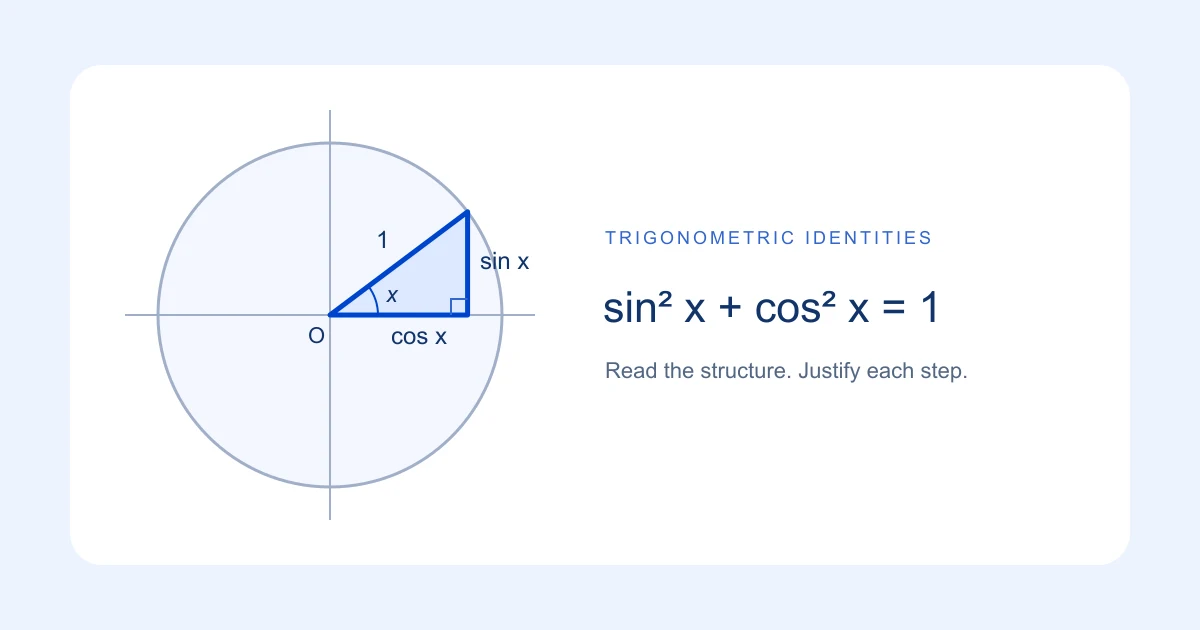
An identity is true for every angle in its stated domain. An equation to solve asks which angles satisfy it. For example, $\sin^2 x+\cos^2 x=1$ is an identity for all real $x$, whereas $\sin x=\frac12$ is true only at particular angles.
In a proof, start with one side and use established identities and valid algebra until you obtain the other side. The target is a destination, not a fact you may assume. It is also valid to simplify each side independently to the same expression, provided neither calculation assumes that the two sides are equal.
The 2026 O-Level Additional Mathematics syllabus includes proofs of simple trigonometric identities in topic G1. Its formulae page supplies supporting identities, but choosing a useful transformation is still your task. See SEAB's 2026 syllabus, pages 7 and 9.
All six questions below are original practice examples for this guide, not past examination questions. Identities work in degrees or radians when you use one angle unit consistently. Conditions such as $\cos x\ne0$ tell you which values are allowed; they are not extra equations to solve.
Read the target before choosing a first step
Compare the two sides before writing any working. Ask what would need to disappear and what would need to appear.
- A target containing $\tan x$ suggests creating $\frac{\sin x}{\cos x}$.
- A difference of squares suggests factorisation before expansion.
- A mixture of $x$ and ${}2x$ suggests matching the angle using a double-angle identity.
- Several different trigonometric functions may become easier to combine when written in sine and cosine.
Starting with the more complicated side is often useful because it offers more things to simplify. It is a heuristic, not a rule: choose the side with a recognisable structure and a clear route to the target. Do not expand every bracket automatically; it may hide a factor you need.
Keep the A Math formula reference nearby. If the identities themselves are unfamiliar, first revise the trigonometric functions guide. Its R-formula section addresses a different task: combining a sine term and a cosine term into one shifted function.
Proof 1: Convert to sine and cosine to reveal a factor
Prove that
$$\frac{\tan x+\sin x}{1+\cos x}=\tan x.$$
Domain: $\cos x\ne0$ and ${}1+\cos x\ne0$. The first condition makes tangent defined; the second keeps the original denominator non-zero.
Read the target. Tangent is sine divided by cosine. The extra sine term on the left suggests replacing tangent first, then combining the numerator into one fraction.
Start with the left-hand side (LHS):
$$\mathrm{LHS}=\frac{\frac{\sin x}{\cos x}+\sin x}{1+\cos x}.$$
Put the numerator over the common denominator $\cos x$:
$$\mathrm{LHS}=\frac{\sin x+\sin x\cos x}{\cos x(1+\cos x)}.$$
Factorise the whole numerator. Now there is a common factor, not merely a matching term:
$$\mathrm{LHS}=\frac{\sin x(1+\cos x)}{\cos x(1+\cos x)}.$$
Cancel ${}1+\cos x$, which is non-zero on the stated domain:
$$\mathrm{LHS}=\frac{\sin x}{\cos x}=\tan x=\mathrm{RHS}.$$
Why this first step works: it exposes exactly the factor already present in the denominator. Converting to sine and cosine is useful here because it creates structure, not because every proof must begin that way.
Proof 2: Factorise before cancelling
Prove that
$$\frac{1-\sin^4 x}{\cos^2 x}=1+\sin^2 x.$$
Domain: $\cos x\ne0$.
Read the target. The target has ${}1+\sin^2 x$. The numerator is a difference of squares: ${}1-(\sin^2 x)^2$. Factorising it creates the target as one factor.
$$\mathrm{LHS}=\frac{(1-\sin^2 x)(1+\sin^2 x)}{\cos^2 x}.$$
Use ${}1-\sin^2 x=\cos^2 x$:
$$\mathrm{LHS}=\frac{\cos^2 x(1+\sin^2 x)}{\cos^2 x}.$$
Since $\cos x\ne0$, cancel the common factor:
$$\mathrm{LHS}=1+\sin^2 x=\mathrm{RHS}.$$
Why this first step works: factorisation lowers the powers and produces something the Pythagorean identity can replace. Rewriting the denominator immediately is possible, but factorising the numerator makes the route easier to see.
Do not replace ${}1-\sin^4 x$ with $(1-\sin^2 x)^2$. Expanding that square gives ${}1-2\sin^2 x+\sin^4 x$, a different expression.
Proof 3: Choose the double-angle form that helps the denominator
Prove that
$$\frac{\sin 2x}{1+\cos 2x}=\tan x.$$
Domain: $\cos x\ne0$. This also ensures ${}1+\cos 2x=2\cos^2 x\ne0$.
Read the target. The right side uses angle $x$, so change the double angles on the left into expressions in $x$. Choose $\cos 2x=2\cos^2 x-1$ because the $-1$ cancels the $+1$ in the denominator.
$$\mathrm{LHS}=\frac{2\sin x\cos x}{1+(2\cos^2 x-1)}.$$
Simplify the denominator:
$$\mathrm{LHS}=\frac{2\sin x\cos x}{2\cos^2 x}.$$
Cancel ${}2\cos x$, which is non-zero here:
$$\mathrm{LHS}=\frac{\sin x}{\cos x}=\tan x=\mathrm{RHS}.$$
A valid but longer route: choosing $\cos 2x=1-2\sin^2 x$ gives ${}2-2\sin^2 x=2\cos^2 x$ in the denominator. This is not wrong; it simply needs another identity. Judge a route by whether it makes progress, not whether it matches a memorised solution exactly.
A worked wrong turn: cancelling terms instead of factors
Suppose you encounter this expression:
$$\frac{\sin x+\cos x}{\sin x},\qquad \sin x\ne0.$$
Crossing out the two appearances of $\sin x$ and leaving $\cos x$ is invalid. The numerator is a sum, so sine is not a factor of the whole numerator.
At $x=45^\circ$, the original expression is ${}2$, whereas $\cos45^\circ=\frac{\sqrt2}{2}$. That counterexample disproves the proposed cancellation.
The valid simplification divides each numerator term by the denominator:
$$\frac{\sin x+\cos x}{\sin x}=1+\frac{\cos x}{\sin x}.$$
Compare Proof 1: cancellation became valid only after the numerator was written as a product. Before cancelling, ask: Does this factor multiply the entire numerator and the entire denominator, and is it non-zero?
There is a separate logical trap: writing the desired equality as if it were known, then rearranging until you reach ${}1=1$. That does not by itself establish a proof. A false equality such as ${}1=-1$ also becomes ${}1=1$ after squaring. Use scratch work to discover a route, then present justified steps from one side to the other.
Numerical substitutions can expose a mistake, but a few matching values cannot prove an identity for every allowed angle.
A compact method-selection checklist
Before your first line:
- Read the target: which functions, angles and factors should remain?
- State restrictions: check the original denominators and any tangent or secant terms on both sides.
- Choose a promising side: look for an identifiable factor or a direct change of angle.
- Choose one move: convert mixed functions to sine/cosine; factorise a difference of squares; or select a double-angle form that simplifies a sum or difference.
- Check progress: did the move reduce different angles, reveal a factor, or approach the target?
- Finish the argument: reach the exact other side, keeping the original domain even if a denominator disappears.
If you get stuck, circle the first line you cannot justify. If you cannot identify an identity, return to the formula reference. If you see the identity but cannot simplify the fractions, practise that algebra separately. If your working is valid but long, compare it with another route and identify the step that shortened it.
If you would benefit from teaching support with these decisions, explore A Math tuition and bring an attempted proof so you can explain where you became stuck.
Three practice questions
For each question, write your intended first move in words before beginning. Prove each identity on the domain stated; do not solve for individual angles.
Question 1 — for $\cos x\ne0$:
$$(\sec x-\tan x)(1+\sin x)=\cos x.$$
Question 2 — for ${}1-2\sin^2 x\ne0$:
$$\frac{\cos^4 x-\sin^4 x}{1-2\sin^2 x}=1.$$
Question 3 — for $\sin x\ne0$ and $\cos x\ne0$:
$$\frac{1-\cos 2x}{\sin 2x}=\tan x.$$
Pause here and attempt all three before reading the complete solutions below.
Practice solutions and domain checks
Solution 1: convert the reciprocal functions. Use $\sec x=1/\cos x$ and $\tan x=\sin x/\cos x$:
$$\mathrm{LHS}=\frac{1-\sin x}{\cos x}(1+\sin x).$$
The two numerator factors form a difference of squares:
$$\mathrm{LHS}=\frac{1-\sin^2 x}{\cos x}=\frac{\cos^2 x}{\cos x}=\cos x=\mathrm{RHS}.$$
Cancellation is valid because $\cos x\ne0$. Although the final expression exists when cosine is zero, the original secant and tangent do not. Keep the restriction.
Solution 2: factorise the difference of fourth powers.
$$\mathrm{LHS}=\frac{(\cos^2 x-\sin^2 x)(\cos^2 x+\sin^2 x)}{1-2\sin^2 x}.$$
The second numerator factor is ${}1$. In the first, replace $\cos^2 x$ by ${}1-\sin^2 x$:
$$\mathrm{LHS}=\frac{(1-2\sin^2 x)\cdot1}{1-2\sin^2 x}=1=\mathrm{RHS}.$$
The stated denominator condition makes this cancellation valid. In particular, $x=45^\circ$ is excluded: the original fraction would be ${}0/0$, not ${}1$.
Solution 3: match the minus sign. Choose $\cos 2x=1-2\sin^2 x$ so the numerator becomes ${}2\sin^2 x$:
$$\mathrm{LHS}=\frac{1-(1-2\sin^2 x)}{2\sin x\cos x}=\frac{2\sin^2 x}{2\sin x\cos x}.$$
Cancel ${}2\sin x$, then recognise tangent:
$$\mathrm{LHS}=\frac{\sin x}{\cos x}=\tan x=\mathrm{RHS}.$$
Both sine and cosine must be non-zero because the original denominator is $\sin 2x=2\sin x\cos x$. At $x=0^\circ$, tangent is defined, but the original fraction is not. Simplifying a fraction does not fill a hole in its original domain.
Compare this with Proof 3: a plus sign suggested the cosine-squared form; a minus sign suggested the sine-squared form. The expression surrounding the identity guides the choice.
Conclusion
The key skill is explaining why a transformation helps. Compare the starting expression with the target, choose one useful move, and justify each line.
Action Steps:
Attempt one practice proof without reading its solution.
Label each transformation with its identity or algebraic reason.
Check every cancelled factor and retain the original domain.
Redo a question using the clue you missed the first time.