

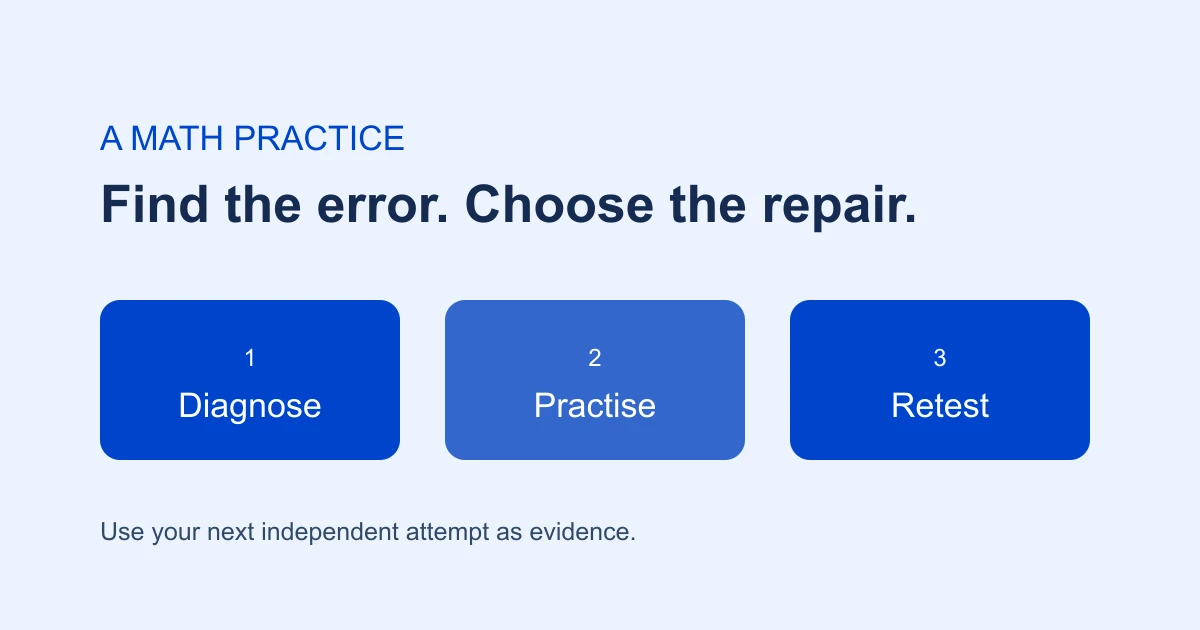
To improve A Math, find the first step you cannot explain or execute correctly, then practise that specific skill and retest it without the solution.
This guide is for students already taking Additional Mathematics who keep making the same mistakes. A low score alone cannot tell you whether you need algebra practice, a clearer concept, help choosing a method, better written working or timed practice.
Try the short diagnostic, compare your reasoning with the corrections, and use the error log to choose your next practice session.
Classify the first error, not just the topic or final wrong answer.
Repair algebra and concepts before treating every unfinished question as a speed problem.
Retest with a changed question and closed notes.
Use written attempts to ask for precise feedback.
Start with five small checks
Use a blank page and show your working before reading the answers below. This is a practice diagnostic, not a validated test or a prediction of your grade. A question can reveal more than one difficulty.
- Algebra: Simplify $\frac{x^2-9}{x-3}$ and state any restriction.
- Concept: Solve $\log_2(x-1)+\log_2(x-3)=3$ over the real numbers.
- Method selection: Find the minimum value of ${2x^2-8x+11}$ without calculus. Explain why your method fits the question.
- Presentation: For $y=x^3-3x$, find the stationary points and justify their nature. Include coordinates and a test.
- Timed work: Choose a short mixed set on topics you have learnt. Attempt it under a time limit agreed with your teacher. Mark unfinished questions, then continue in a different colour without notes. Can you now solve them correctly, or are you still stuck on the mathematics?
Do not turn these checks into a total score. Record the first line where your working breaks and whether a hint, a formula or extra time was needed.
Algebra: cancel factors, and keep the restriction
Incorrect shortcut: Cancelling the $x$ terms or the 3s separately across a fraction does not preserve its value.
Factorise the entire numerator first:
$$\frac{x^2-9}{x-3}=\frac{(x-3)(x+3)}{x-3}=x+3.$$
This simplification requires $x\ne3$.
The restriction remains because the original denominator is zero at $x=3$. The simplified expression agrees with the original only on its original domain.
Practice: Work on factorisation and cancellation together, rather than doing an unrelated calculus worksheet. For each fraction, identify the common factor and write the excluded values before cancelling.
Retest: Simplify $\frac{x^2-16}{x+4}$. The answer is $x-4$ for $x\ne-4$. Explain why substituting $x=-4$ into the simplified expression does not make it valid in the original.
Concept: a log equation needs a domain check
Both logarithm arguments must be positive, so $x>3$. The product law gives
$$\log_2[(x-1)(x-3)]=3.$$
Therefore $(x-1)(x-3)=8$, so $x^2-4x-5=0$ and $(x-5)(x+1)=0$. The candidates are ${5}$ and $-1$. Only $x=5$ satisfies $x>3$; substitution gives $\log_2 4+\log_2 2=2+1=3$.
Wrong turn: Writing $\log_2(2x-4)=3$ adds the arguments instead of multiplying them. Keeping $x=-1$ is a separate domain error, even if your algebra is correct.
Practice: Review the logarithm laws and examples. For each equation, write the domain before combining logs, then check every candidate in the original equation.
Retest: Solve $\log_2(x-2)+\log_2 x=3$. Here $x>2$, $x(x-2)=8$, and $(x-4)(x+2)=0$. Only $x=4$ is valid.
Method selection: work backwards from the requested result
For a minimum value without calculus, completing the square makes the lower bound visible:
$$2x^2-8x+11=2(x-2)^2+3.$$
Since $(x-2)^2\ge0$ for real $x$, the minimum is ${3}$, attained at $x=2$.
Wrong turn: Setting the expression equal to zero answers a roots question. It does not directly give its minimum. The quadratic formula is not wrong mathematics; it is answering a different question here.
Practice: Before calculating, label what is wanted: roots, a minimum, a gradient or an identity. Use the A Math formula guide to connect each tool to its purpose.
Retest: Find the minimum of ${3x^2+6x+5}$. Rewriting it as ${3(x+1)^2+2}$ gives minimum ${2}$ at $x=-1$. Say why the square term cannot make the expression smaller.
Presentation: make the conclusion follow from the working
For $y=x^3-3x$,
$$\frac{dy}{dx}=3x^2-3=0\quad\Longrightarrow\quad x=\pm1.$$
Substitution into the original expression gives $(-1,2)$ and $(1,-2)$. Also,
$$\frac{d^2y}{dx^2}=6x.$$
At $x=-1$, the second derivative is $-6<0$, so $(-1,2)$ is a local maximum. At $x=1$, it is ${6>0}$, so $(1,-2)$ is a local minimum.
Incomplete answer: Giving only the two $x$ values omits the coordinates and justification requested. A stationary point is not automatically a maximum or minimum; an inconclusive test needs further reasoning.
Practice: Use the differentiation guide, then write the derivative, stationary condition, coordinates, test and conclusion on separate clear lines.
Retest: For $y=x^3-12x$, the stationary condition is ${3x^2-12=0}$. The points are $(-2,16)$, a local maximum since ${6(-2)<0}$, and $(2,-16)$, a local minimum since ${6(2)>0}$. Check that your written solution supports each label.
Timed work: distinguish slow execution from missing understanding
If extra time lets you finish accurately without help, investigate pacing and fluency. If you still need a worked solution, return to the relevant concept or method first. One attempt is only a clue: compare several pieces of work before deciding.
Practise a short mixed set once the individual methods are reliable. Record where time went: choosing a method, repeated arithmetic, restarting, or checking. Agree a checkpoint with your teacher for moving on from a stalled question and returning later. Keep essential working rather than trying to gain speed by doing everything mentally.
For 2026 O-Level A Math, both papers allow 2 hours 15 minutes for 90 marks, and the syllabus warns that omitting essential working loses marks. These are paper totals, not a rigid time allowance for every question. See SEAB 4049, page 5. Use your own school's instructions for school tests.
An error log that changes the next practice session
Here is an illustrative entry, not a real student's record:
- Question: Simplify $\frac{x^2-9}{x-3}$.
- First incorrect or missing step: I cancelled before factorising and did not record $x\ne3$.
- Diagnosis: Algebra, with a domain omission.
- Correction rule: Factorise first; cancel common factors; retain the original restriction.
- Next practice: Three fractions with different factors. Write restrictions before simplifying.
- Retest: A changed fraction, without notes, at the next session; then one inside a mixed set later.
- Evidence: Record whether both the expression and restriction were correct, and whether help was used.
“Careless mistake” is too vague to guide practice. “Lost the negative sign when expanding the second bracket” tells you what to repair.
A manageable practice and retest routine
Adapt this example cycle around schoolwork; it is not a promise of improvement within a fixed number of days.
- First session: Take two or three recent errors and identify their first failing steps. Choose one recurring issue.
- Repair session: Review one relevant explanation, correct the original attempt and complete a small set on that skill. Mark each answer before repeating an error across a whole page.
- Next session: Attempt changed questions with notes closed. If you cannot explain the method, return to the explanation or ask for feedback.
- Later mixed session: Combine the repaired skill with older topics. Add time pressure only when the untimed method is dependable.
Choose the retest to match the diagnosis: new factors for algebra; domain and law explanations for concepts; mixed prompts for method choice; a complete written argument for presentation; a timed mixed set for pacing. Keep an issue open if it returns.
For trigonometry gaps, use the trigonometric-functions guide rather than starting a new topic simply to feel productive.
When feedback is the useful next step
Bring a teacher your original attempt, correction and changed-question retest. Ask which line first became invalid and what would justify the next step. This gives them more to work with than “I do not understand the chapter”.
If repeated gaps remain difficult to identify independently, compare A Math tuition options at Tim Gan Math with the support you already receive at school. Choose help based on the skills you need to repair; extra lessons are not a substitute for checking your own attempts.
Conclusion
A useful practice plan names the error, repairs the relevant skill and checks whether you can use it again without help.
Action Steps:
Choose one repeated error from a recent script.
Write its correction rule and try a changed question.
Bring both attempts to your teacher if the same gap remains.
Measure the quality of your next independent attempt, not just the number of pages completed.