

A-Level H2 Mathematics · EJC
Eunoia Junior College H2 Math papers, with video solutions
184 prelim, promo and mid-year questions set by Eunoia Junior College between 2017–2026, 136 of them with worked video solutions. Sample questions below are free; the full archive lives in the Question Bank.
Open to everyone
Free EJC sample questions
Try these unlocked questions first — each one works exactly like the 178 others waiting in the Question Bank.
2022 EJC P1 Q10
VideoA spherical container of radius \(5\) m is formed by rotating the following circle \(C\) about the \(y\)-axis.
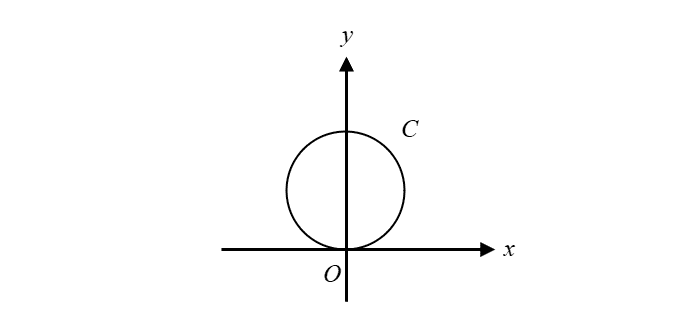
The container has negligible thickness, and the circle \(C\) passes through the origin \(O\).
- State a cartesian equation of \(C\).[1]
Initially the spherical container is completely filled with water. Two engineers are calculating the time needed for the container to be completely drained from a small circular hole at the bottom. The volume of water in the container at time \(t\) seconds is denoted by \(V\) m\(^{3}\).
[The volume of a sphere of radius \(r\) is \(\frac{4}{3}\pi {{r}^{3}}\).]
- The first engineer proposes that the rate of change of \(V\) with respect to \(t\) is a constant \(k\).[1]
- Write down a differential equation relating \(V\), \(t\) and \(k\).[1]
- Determine, with justification, the sign of \(k\).[1]
- Find \(V\) in terms of \(t\) and \(k\), leaving your answer in exact form.[2]
- The second engineer argues that the rate at which water flows out from the hole will be at its greatest in the beginning, and decreases as the depth of water in the container decreases. He suggests using Torricelli’s law, which says that\(\frac{\mathrm{d}V}{\mathrm{d}t}=-\alpha \sqrt{20h}\),where \(\alpha \) m\(^{2}\) is the area of the circular hole at the bottom of the container, and \(h\)m is the depth of water in the container at time \(t\) seconds. The radius of the hole at the bottom of the container is found to be constant at \(1\) cm.
- Show that \(\left( 10{{h}^{\frac{1}{2}}}-{{h}^{\frac{3}{2}}} \right)\frac{\mathrm{d}h}{\mathrm{d}t}=-\frac{\sqrt{5}}{5000}\).[4]
- Hence find the numerical value of \(t\) when the container is completely drained.[4]
2020 EJC P1 Q10
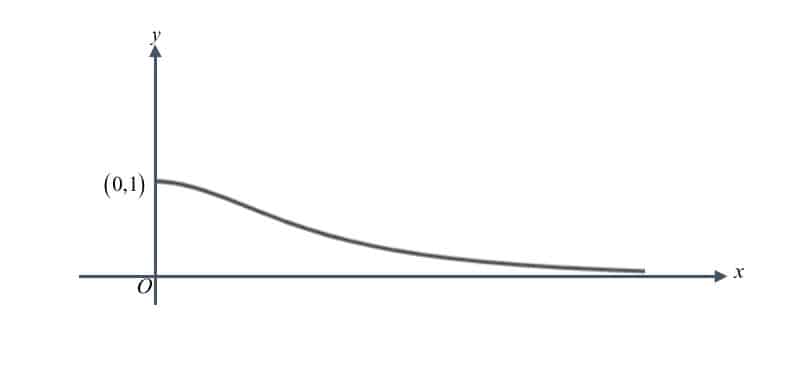
VideoThe diagram shows the graph of $y=\frac{1}{{{x}^{2}}+1}$ when $x>0$.
- Evaluate $\displaystyle\int_{k}^{k+1}{\frac{1}{{{x}^{2}}+1}\mathrm{d}x}$ for $k>0$, leaving your answer in terms of $k$.
[2]
- By considering appropriate rectangles on the interval $\left[ k,k+1 \right]$ for the curve $y=\frac{1}{{{x}^{2}}+1}$, show that$\frac{1}{{{\left( k+1 \right)}^{2}}+1}<{{\tan }^{-1}}\left( k+1 \right)-{{\tan }^{-1}}k<\frac{1}{{{k}^{2}}+1}$ for $k\in {{\mathbb{Z}}^{+}}$.
[2]
- Use the identity $\tan \left( A-B \right)=\frac{\tan A-\tan B}{1+\tan A\tan B}$ to show that${{\tan }^{-1}}x-{{\tan }^{-1}}y={{\tan }^{-1}}\frac{x-y}{1+xy}$, where $x>y>0$.
[2]
- By considering parts (ii) and (iii), prove by the method of differences that$\sum\limits_{k=1}^{n}{\frac{1}{{{\left( k+1 \right)}^{2}}+1}}<{{\tan }^{-1}}\left( \frac{n}{n+2} \right)<\sum\limits_{k=1}^{n}{\frac{1}{{{k}^{2}}+1}}$
[4]
2020 EJC Promo Q10
VideoFunctions \(\mathrm{f}\) and \(\mathrm{g}\) are defined by
\(\mathrm{f}:x\mapsto {{x}^{3}}-7{{x}^{2}}-5x+11\), \(x\in \mathbb{R}\), \(x\ge k\),
\(\mathrm{g}:x\mapsto {{\left( x+1 \right)}^{2}}+2\),\(x\in \mathbb{R}\).
- Let \(k=1\).
- Show that \(\mathrm{f}\) does not have an inverse.[2]
- Determine whether the composite function \(\mathrm{fg}\) exists.[2]
- Find the value of \(k\) given that \({{\mathrm{f}}^{-1}}\) exists and that the domain of \({{\mathrm{f}}^{-1}}\) is \(x\in \mathbb{R}\), \(x\ge -24\).[2]
- Let \(k=6\).
- Show algebraically that \(\mathrm{f}'(x)>0\) for all values of \(x\) in the domain of \(\mathrm{f}\).[2]
- Solve the equation \(\mathrm{g}{{\mathrm{f}}^{-1}}(x)=83\).[3]
2020 EJC P1 Q2
VideoState the derivative of \(\tan {{x}^{2}}\). Hence, or otherwise, find \(\displaystyle\displaystyle \displaystyle\int{{{x}^{3}}{{\sec }^{2}}{{x}^{2}}\mathrm{d}x}\)[4]
2018 EJC P1 Q3
VideoThe parametric equations of curve $C$, is given as $x=at$, $y=a{{t}^{3}}$, where $a$ is a positive constant.
- The point $P$ on the curve has parameter $p$ and the tangent to the curve at point $P$ cuts the $y$-axis at $S$ and the $x$-axis at $T$. The point $M$ is the midpoint of $ST$. Find a Cartesian equation of the curve traced by $M$ as $p$ varies.
[5]
- Find the exact area bounded by curve $C$, the line $x=0$, $x=3$ and $x$-axis, giving your answer in terms of $a$.
[3]
2018 EJC JC2 MYE P2 Q4
VideoA tank has a capacity of 100 litres. Initially, the tank contains 10 litres of water thoroughly mixed with 300 grams of salt. Salt water with a concentration of 5 g/litre is poured into the tank at a constant rate of 2 litres per minute, while the mixture flows out at a constant rate of 1 litre per minute.
Let \(S\) denote the amount of dissolved salt in the tank (in grams) at time \(t\) minutes after salt water is poured into the tank.
- Show that \(\frac{\mathrm{d}S}{\mathrm{d}t}=10-\frac{S}{t+10}\), stating your assumption(s) clearly.[2]
- By substituting \(Q=\left( t+10 \right)S\), solve the differential equation in (i), and find \(S\) in terms of \(t\).[4]
- Hence, find the concentration of salt in the tank at the point just before it overflows.[2]
Once the volume of salt solution in the tank reaches 100 litres, the pouring stops, and the tank is allowed to drain off. The salt solution drains from the tank at a rate proportional to the volume of solution in the tank. Let \(V\) denote the volume of solution in the tank at time \(T\) after the tank starts to drain off.
- If the tanks takes 10 minutes to drain half of its contents, find \(V\) in terms of \(T\).[4]
In the Question Bank
Every EJC paper we hold
2026 Prelim
22 questions- P1 Q1
- P1 Q2
- P1 Q3
- P1 Q4
- P1 Q5
- P1 Q6
- P1 Q7
- P1 Q8
- P1 Q9
- P1 Q10
- P1 Q11
- P2 Q1
- P2 Q2
- P2 Q3
- P2 Q4
- P2 Q5
- P2 Q6
- P2 Q7
- P2 Q8
- P2 Q9
- P2 Q10
- P2 Q11
2025 Prelim
21 questions12 video- P1 Q1
- P1 Q2
- P1 Q3
- P1 Q4
- P1 Q5
- P1 Q6
- P1 Q7
- P1 Q8
- P1 Q9
- P1 Q10
- P1 Q11
- P2 Q1
- P2 Q2
- P2 Q3
- P2 Q4
- P2 Q5
- P2 Q6
- P2 Q7
- P2 Q8
- P2 Q9
- P2 Q10
2025 Promo
13 questions5 video- P1 Q1
- P1 Q2
- P1 Q3
- P1 Q4
- P1 Q5
- P1 Q6
- P1 Q7
- P1 Q8
- P1 Q9
- P1 Q10
- P1 Q11
- P1 Q12
- P1 Q13
2024 Prelim
10 questions8 video- P1 Q4
- P1 Q7
- P1 Q9
- P1 Q11
- P2 Q2
- P2 Q5
- P2 Q6
- P2 Q7
- P2 Q9
- P2 Q11
2024 Promo
13 questions8 video- Q1
- Q2
- Q3
- Q4
- Q5
- Q6
- Q7
- Q8
- Q9
- Q10
- Q11
- Q12
- Q13
2023 Prelim
13 questions13 video- P1 Q3
- P1 Q8
- P1 Q9
- P2 Q1
- P2 Q3
- P2 Q4
- P2 Q5
- P2 Q6
- P2 Q7
- P2 Q8
- P2 Q9
- P2 Q10
- P2 Q11
2023 Promo
7 questions6 video- Q3
- Q4
- Q6
- Q7
- Q8
- Q9
- Q12
2022 Prelim
6 questions6 video- P1 Q1
- P1 Q4
- P1 Q10
- P2 Q6
- P2 Q7
- P2 Q8
2022 Promo
11 questions10 video- Q2
- Q3
- Q3
- Q4
- Q5
- Q6
- Q7
- Q8
- Q10
- Q11
- Q12
2022 Mid-Year Exam
12 questions12 video- Q2
- Q3
- Q5
- Q8
- Q8
- Q10
- P1 Q2
- P1 Q8
- P2 Q6
- P2 Q8
- P2 Q9
- P2 Q10
2021 Prelim
9 questions9 video- P1 Q2
- P1 Q5
- P1 Q8
- P2 Q1
- P2 Q2
- P2 Q6
- P2 Q8
- P2 Q9
- P2 Q10
2021 Promo
4 questions4 video- Q1
- Q3
- Q9
- Q11
2021 Mid-Year Exam
2 questions2 video- P1 Q10
- P2 Q9
2020 Prelim
11 questions11 video- P1 Q2
- P1 Q4
- P1 Q7
- P1 Q9
- P1 Q10
- P2 Q2
- P2 Q4
- P2 Q5
- P2 Q7
- P2 Q8
- P2 Q9
2020 Promo
4 questions4 video- Q2
- Q6
- Q7
- Q10
2019 Prelim
7 questions7 video- P1 Q2
- P1 Q7
- P1 Q11
- P2 Q2
- P2 Q3
- P2 Q7
- P2 Q9
2019 Promo
3 questions3 video- Q3
- Q4
- Q6
2018 Prelim
7 questions7 video- P1 Q1
- P1 Q3
- P1 Q6
- P1 Q7
- P2 Q2
- P2 Q8
- P2 Q11
2018 Promo
5 questions5 video- Q5
- Q6
- Q8
- Q9
- Q10
2018 Mid-Year Exam
1 question1 video- P2 Q4
2017 Promo
2 questions2 video- Q5
- Q7
Work through these papers in the Question Bank
Membership opens every EJC question above — and the full archive from 26 other junior colleges. Missing a video? Request it inside the Question Bank and we'll queue it.
Done with prelims? The A-Level papers are free
Every national A-Level H2 Math question we hold is open to everyone, each with a video solution.