

Algebraic manipulation is not one chapter to finish and forget. It is the working language behind equations, graphs, trigonometry, coordinate geometry and eventually calculus.
The jump into Secondary 1 or IP1 can feel abrupt. In primary school, students may rely heavily on model methods and arithmetic. Secondary Mathematics asks them to express relationships with letters, preserve equality through several steps and explain their working in a form another person can follow.
This guide explains what to practise first, why common expansions fail, and how to divide one focused session between algebra fluency and real application without becoming dependent on notes, answer keys or AI.
Split algebra practice into two modes: pure manipulation for fluency, then application in equations or word problems.
Name the exact skill being practised, such as negative coefficients, quadratic expansion or algebraic fractions, instead of doing a random worksheet.
Learn enough of the concept to begin, then use questions to expose the assumptions that still need correction.
For every error, ask why the step is invalid and reattempt the question without looking at the solution.
AI can provide a hint or explanation, but it should not remove the productive struggle required to build algebraic fluency.
What Is Algebraic Manipulation?
Algebraic manipulation means rewriting an expression or equation into an equivalent form while preserving its mathematical meaning. It includes collecting like terms, expanding brackets, factorising, simplifying algebraic fractions, changing the subject of a formula and solving equations.
The important word is equivalent. You are not moving symbols according to a visual pattern. You are carrying out valid operations that leave the value or relationship unchanged.
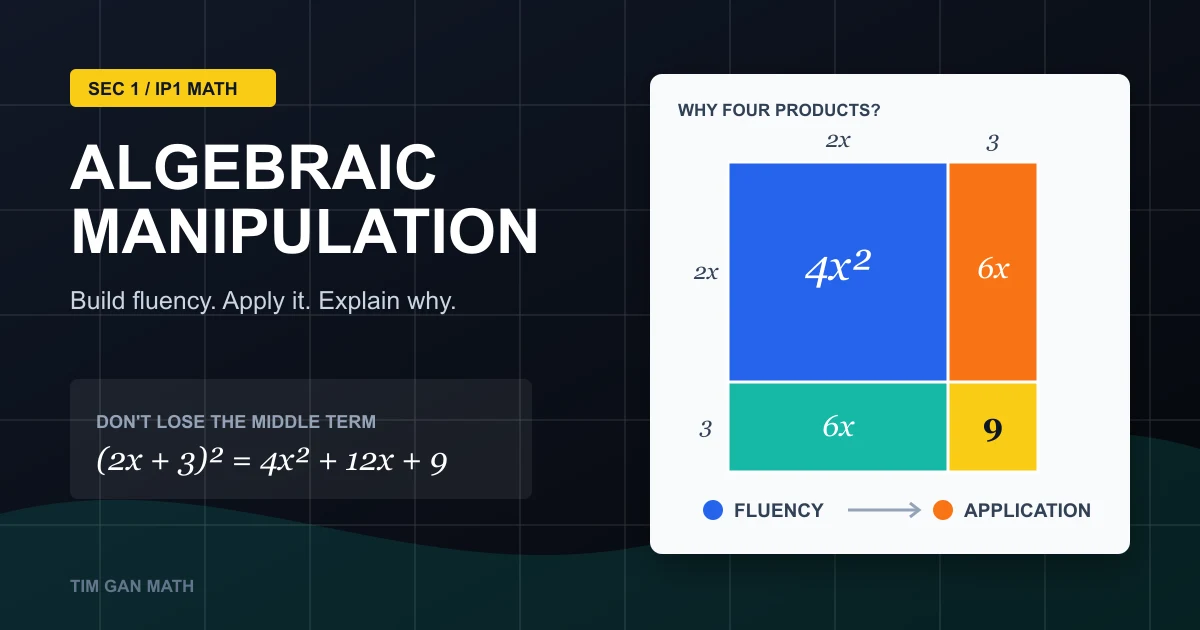
For example, expanding $(2x+3)^2$ is not a memory test about where to place a square. It asks you to multiply $(2x+3)(2x+3)$ correctly. A student who understands that structure can reconstruct the result even when a memorised identity is forgotten.
Why Algebra Feels Different After Primary School
The transition is real. The updated MOE Primary Mathematics syllabus introduces letters as unknown numbers, simple linear expressions without brackets, substitution and simple linear equations.
By contrast, the 2027 SEAB G3 Mathematics syllabus includes expansion, factorisation, quadratic expressions, changing the subject and operations with algebraic fractions. The student is no longer only finding one unknown number. They must manipulate whole expressions accurately.
This is also why a high PSLE score does not automatically guarantee effortless Secondary Math. Some capable students are used to solving mentally or through a model, and they resist writing a new method line by line. But Mathematics is a language. A correct answer with working that nobody can follow is not yet a complete mathematical explanation.
This same transition is especially visible in IP schools, where pacing and assessment can differ. Our guide to why strong students struggle with IP Math explains the wider adjustment.
Practise the Exact Algebra Skill, Not a Vague Topic
Before opening a worksheet, name the operation you are training. "I am doing algebra" is too broad. A useful focus sounds like one of these:
- Collecting like terms with negative coefficients
- Expanding one or two brackets
- Factorising linear or quadratic expressions
- Simplifying algebraic fractions
- Rearranging a formula
- Translating a word problem into an equation
This distinction matters because two students can both say they are weak in algebra while having completely different gaps. One loses negative signs. Another does not understand what can be cancelled in a fraction. A third manipulates expressions well but cannot form an equation from a word problem. For that third gap, use the companion guide on how to solve Math word problems, which focuses on context, unknowns and relationships.
Begin with the earliest unstable skill. Quadratic expressions and negative coefficients frequently expose gaps because one incorrect assumption can affect every line that follows. Once that manipulation is dependable, place it inside an application so the student learns when and why to use it.
A Common Error: Why Two x Plus Three Squared Has a Middle Term
A common incorrect expansion is:
$$ (2x+3)^2 = 4x^2+9 $$
The student has squared the first and last terms but lost the two cross-products. Write the square as multiplication:
$$ (2x+3)^2=(2x+3)(2x+3) $$
Now account for all four products:
- First terms: $(2x)(2x)=4x^2$
- Outer terms: $(2x)(3)=6x$
- Inner terms: $(3)(2x)=6x$
- Last terms: $(3)(3)=9$
Therefore:
$$ (2x+3)^2=4x^2+12x+9 $$
An area diagram gives the same four regions: one $4x^2$ square, two $6x$ rectangles and one $9$ square. The identity $(a+b)^2=a^2+2ab+b^2$ is therefore a compact description of the structure, not an arbitrary formula.
When a student makes this mistake, simply marking it wrong is not enough. Ask: Which multiplication disappeared? Why must it be included? Can I explain the result with an area model? That challenge to the original assumption is where the learning happens.
A 40-Minute Algebraic Manipulation Practice Routine
A productive session should train both fluency and transfer. Pure manipulation builds accuracy and speed; application shows whether the student can recognise when the algebra is needed. Do not measure the session only by the number of completed questions.
From fluent steps to independent application
Choose one narrow algebra skill and complete the entire cycle before switching topics.
- 3 min
Choose one precise target
State the exact focus, such as expanding quadratics with negative coefficients or adding algebraic fractions.
Ready to move on when: You can describe what the worksheet is testing in one sentence.
- 20 min
Build manipulation fluency
Attempt a small, progressive set containing the same core operation. Work without referring continuously to notes.
Ready to move on when: Your steps are accurate and another person can follow the working.
- 10 min
Apply the algebra
Use the same operation inside an equation, formula, graph question or word problem.
Ready to move on when: You can recognise that the application depends on the skill practised earlier.
- 5 min
Interrogate one error
Identify the first invalid step, explain why it is invalid and state the rule or idea that repairs it.
Ready to move on when: You understand the cause rather than merely replacing your answer with the model solution.
- 2 min
Reattempt from a blank page
Close every source of help and reconstruct the key question or a close variation independently.
Ready to move on when: The method can be retrieved, not merely recognised when you see it.
You should finish able to name the skill, execute it accurately, apply it in context and explain one corrected mistake without support.
Learn Enough Concept to Start, Then Let Questions Teach You
Students sometimes postpone practice because they believe they must finish every concept in the notes first. That is not how mathematical understanding usually develops.
Learn the basic meaning and operation well enough to begin. Then attempt a carefully chosen question. The question reveals whether the concept survives a negative coefficient, a fraction, an unfamiliar arrangement or a worded context. Each new difficulty is like reaching the next level of a game: it shows which part of the concept needs to become more flexible.
This is different from blind drilling. After every wrong answer, ask:
- What type of expression or application was this?
- Which line was the first line that became invalid?
- Was the problem conceptual, procedural or careless?
- Why is the correct operation valid?
- Can I now solve a similar question without the explanation?
Depth matters more than volume. Five questions that reveal and repair one recurring misconception can be more valuable than thirty questions completed while repeating it.
How to Use AI Without Outsourcing the Algebra
Instant solutions create a new temptation. When a question becomes uncomfortable, a student can photograph it, ask AI for the answer and move on before doing any mathematical thinking. The page may look completed, but the student has not built the ability to begin independently.
Use an attempt-first rule:
- Classify the expression or problem.
- Write the first step you believe might work.
- If stuck, request the smallest useful hint rather than the complete answer.
- Check the explanation against trusted notes or worked solutions.
- Close the help and reattempt from the beginning.
Students also need to protect the practice block from phone and social-media interruptions. The difference between stronger and weaker learners is often not access to answers; it is how long they remain engaged with a difficult thought before giving up. Read our evidence-led guide on how to study Math in the age of AI for a fuller support ladder based on student interviews.
The Final Test: Can You Teach the Algebra?
Explaining a method to a classmate is one of the clearest tests of understanding. It forces you to name each operation, justify it and notice the step you previously treated as obvious.
Try explaining why two unlike terms cannot be collected, why cancelling across addition is invalid, or why a quadratic expansion has a middle term. If the explanation becomes vague, return to the diagram, definition or distributive law behind the technique.
There is no special type of student who is born able to manipulate algebra. Fluency develops through a proper system: a narrow target, deliberate practice, honest correction, application and retrieval. This foundation also matters when deciding whether to take Additional Mathematics. The 2027 SEAB G3 Additional Mathematics syllabus states that strong algebraic manipulation and mathematical reasoning are required for later H2 Mathematics. The Sec 2 A Math readiness checklist shows how algebra, formal working and practice habits combine.
Conclusion
Algebraic manipulation improves when students stop treating it as a collection of formulas and start treating it as a language of equivalent steps. Practise the operation, apply it, investigate the first wrong line and retrieve the method without help.
Action Steps:
Choose one precise weakness instead of revising all of algebra at once.
Spend 20 minutes building manipulation fluency, followed by 10 minutes of application.
Explain why one error is wrong before checking off the correction.
Reattempt from a blank page and teach the method to someone else.
Every student can improve at algebra, but access to more answers is not the same as learning. The progress comes from staying with the problem long enough to understand why each line works.