

A long Math word problem is not automatically a difficult Math problem. Sometimes its size makes a student decide, before reading it properly, that they cannot solve it.
That mental shutdown is often the first obstacle. The next obstacles are translation: understanding what each quantity means, deciding how the quantities are related, and choosing the fewest useful unknowns. A student may be fluent at algebraic manipulation yet still struggle to turn a real-world situation into an equation.
This guide shows Secondary 1, IP and lower-secondary students how to break a word problem into manageable parts, interpret words such as difference correctly, and translate a relationship into algebra without overcomplicating it.
Do not judge a problem by the number of words. Read the first instruction and use the scaffolding one part at a time.
Define what each quantity represents before calculating. Context determines what an answer or operation means.
Use the fewest unknowns that describe the relationship clearly. Two quantities do not always require two variables.
Translate relationships before solving: larger, smaller, more than, less than, total and difference each connect quantities in a specific way.
Check the final answer against the original context, including its sign, size, units and every stated relationship.
The Direct Answer: Word Problems Are Translation Problems
Students often say, "I can do the algebra, but I cannot do word problems." The missing skill is usually translation.
A word problem moves through three languages:
- The real-world situation described in words
- A mathematical model such as an expression, equation, table or diagram
- An answer interpreted back in the original situation
The algebra may be simple once the model is formed. The difficult part is deciding what the words mean mathematically. This is a genuine examination skill, not an optional extra. The 2027 SEAB G3 Mathematics syllabus assesses whether students can identify relevant mathematics, translate information, formulate problems in mathematical terms and interpret results in context.
So the aim is not to hunt for numbers and calculate immediately. It is to turn the situation into a small, accurate mathematical structure.
Why Students Freeze Before Doing Any Mathematics
A large block of text can create a mental blockage. Students see unfamiliar names, units, a diagram and several sentences, then tell themselves the question is too hard. Once that conclusion is made, they stop looking for information they already know how to use.
Reset the first response:
- Cover the later parts if the page feels overwhelming.
- Read only the opening situation and part (a).
- Underline what is known and circle what must be found.
- Write one relationship before attempting any calculation.
Many examination questions are scaffolded. The result from part (a) may define a quantity used in part (b), and part (b) may prepare the equation for part (c). Treating the whole page as one giant problem hides that structure.
Confidence here is behavioural, not motivational. Do the first small mathematical action even while the question still feels uncomfortable.
Context Comes Before Calculation
The same mathematical word can require careful interpretation in different situations. Consider the word difference.
If one amount is larger and the question asks for the difference between the amounts, it usually means the non-negative gap:
$$ \text{difference}=\text{larger value}-\text{smaller value} $$
If the quantities have not been ordered, the gap may be represented as an absolute difference, $|x-y|$. But a question about change over time may use final value minus initial value, which can be negative. The context decides.
Before forming an equation, state what the symbols mean and include units where relevant:
- $x$ is the larger amount in dollars.
- $t$ is the time in hours after the journey begins.
- $n$ is the number of tickets, so $n$ must be a whole number.
These definitions prevent technically possible but contextually impossible answers. A negative number of tickets, a decimal number of people or a smaller value labelled as the larger one should trigger a review.
Use the Fewest Useful Unknowns
Students sometimes introduce one variable for every quantity they see. That can create more work than the problem requires.
Suppose a question says:
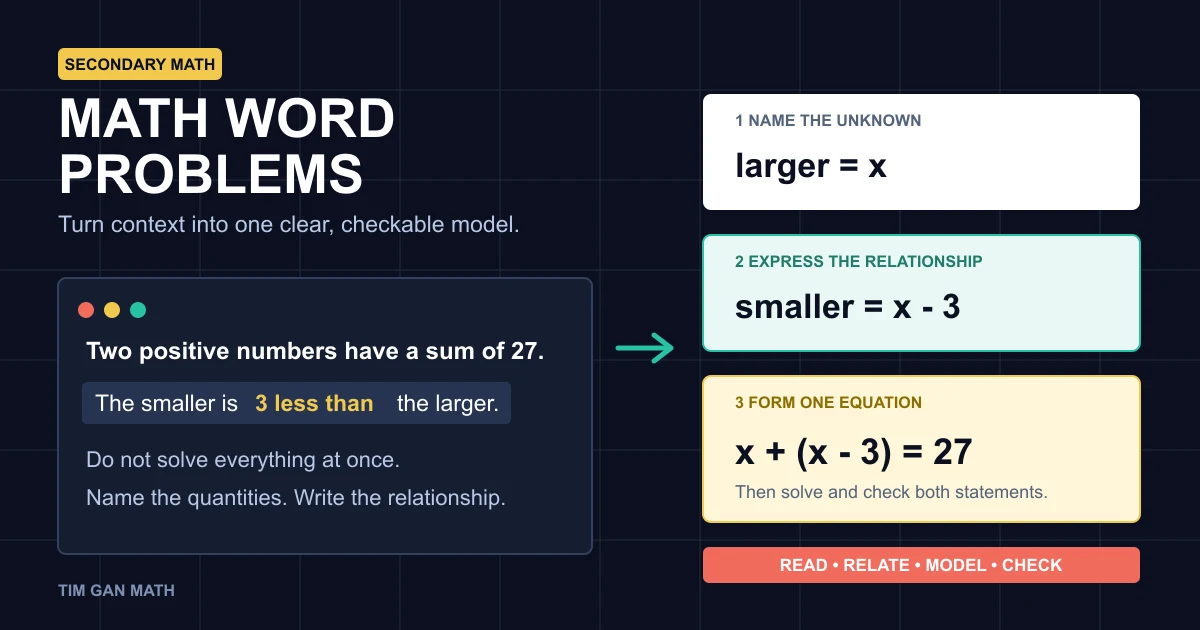
Two positive numbers have a sum of 27. The smaller number is 3 less than the larger number. Find both numbers.
A student may write "let the numbers be $x$ and $y$". That is possible, but it creates two unknowns and then requires two equations. The relationship lets us express both numbers using one unknown.
Let the larger number be $x$. Then the smaller number is $x-3$. Their sum gives:
$$ x+(x-3)=27 $$
Solve the equation:
$$ 2x-3=27 $$
$$ 2x=30 $$
$$ x=15 $$
Therefore, the larger number is 15 and the smaller number is $15-3=12$.
Check both statements: $15+12=27$ and $15-12=3$. The answer satisfies the total and the difference.
The important move was not solving the linear equation. It was recognising that "3 less than the larger number" can be written as $x-3$. Students who need to strengthen the mechanics can use our linear equations guide; students who lose accuracy during expansion, signs or fractions should first revisit algebraic manipulation for Sec 1.
A Five-Step Method for Solving Math Word Problems
Use the same translation routine until it becomes automatic. The exact diagram or equation will change, but the decisions remain stable.
From a long question to one checkable model
Complete each decision in order. Do not start calculating while the quantities and relationships are still vague.
- Step 1
Reset and read one part
Ignore the visual length. Read the opening context and the first instruction without trying to solve the whole page.
Ready to move on when: You can state what the question is asking in your own words.
- Step 2
Name the quantities
List what is known, what is unknown and the units or restrictions attached to each quantity.
Ready to move on when: Every symbol has a precise meaning, not just a letter.
- Step 3
Write the relationships
Translate phrases such as total, difference, three less than, twice as many or constant rate before solving.
Ready to move on when: You can explain each expression in words.
- Step 4
Choose and solve the model
Use the fewest useful unknowns, form the equation or representation, then carry out the required mathematics.
Ready to move on when: Every equation follows from a stated relationship in the question.
- Step 5
Return to the context
Check the sign, size, units, restrictions and all original statements before writing the final answer.
Ready to move on when: The result is mathematically valid and realistic for the situation.
You should finish with an answer that satisfies the mathematics and makes sense in the original situation.
Common Translation Mistakes and What They Reveal
A wrong equation is useful evidence. Instead of saying "I am bad at word problems", identify the decision that failed.
Mistake 1: Using every number immediately
Not every number belongs in the first calculation. Some values describe a condition, a later part or irrelevant context. Decide the relationship before choosing an operation.
Mistake 2: Treating keywords as automatic commands
"More" does not always mean add every visible number, and "difference" does not always mean subtract in the order the values appear. Read the complete sentence.
Mistake 3: Introducing too many unknowns
If one quantity is already described in terms of another, use that relationship. Writing $x$ and $x-3$ can be clearer than introducing $x$ and $y$.
Mistake 4: Solving correctly but answering the wrong quantity
Finding $x$ is not necessarily the final answer. If $x$ represents the larger number but the question asks for the smaller number, one more step is required.
Mistake 5: Ignoring an impossible result
A negative length or non-whole number of people may show that the model, algebra or interpretation is wrong. Context is part of the checking process.
For IP students, the deeper issue can be resistance to writing formal working because the answer feels obvious. Our guide to why capable students struggle with IP Math explains why mathematical communication becomes more important after primary school.
How to Practise Word Problems Without Random Drilling
Exposure matters because students need to see how the same relationship appears in different contexts. But random volume is not enough. Group practice by the decision being trained.
A useful progression is:
- Translate phrases into expressions without solving.
- Define one unknown and express a related quantity using it.
- Form one equation from a short context.
- Solve a scaffolded multi-part problem.
- Attempt a longer real-world problem that combines topics.
After each error, ask:
- Did I misunderstand the context?
- Did I define the unknown unclearly?
- Did I translate the relationship incorrectly?
- Was the model correct but the algebra weak?
- Did I forget to interpret or check the result?
This separates translation mistakes from algebra mistakes. If the equation was correct but the solution process failed, return briefly to manipulation practice. If the algebra was correct but the equation was wrong, practise forming models rather than doing more routine equations.
Structured secondary resources with worked explanations can make this comparison easier. Our E Math assessment-book guide explains how to use a solution after an honest attempt rather than merely copying the final line.
How AI Can Help Without Removing the Thinking
AI can explain a phrase, generate a similar problem or check whether an equation matches a context. It should not make the central translation decision before the student has tried.
Use a narrow request such as:
- "Do not solve this. Ask me questions that help me identify the unknown."
- "Check only whether my variable definitions are clear."
- "Give me one hint about the relationship, not the equation."
- "Create a similar problem with different values after I finish this one."
Then close the explanation and form the model independently. An instant full solution can create recognition without recall: the reasoning looks obvious when shown, but the student still cannot begin the next problem.
Our student-interview guide on studying Math in the age of AI gives a fuller attempt-first support ladder for written solutions, videos, photo search and AI.
Conclusion
Math word problems become manageable when students stop treating the entire paragraph as one obstacle. Read one part, define the quantities, translate the relationships, use the fewest useful unknowns and check the answer in context.
Action Steps:
Take one word problem and underline only the known quantities and required result.
Define the unknown with its meaning and unit before writing an equation.
Express related quantities using the same unknown where possible.
Check every answer against the original total, difference, restriction and context.
The student who improves is not the one who never feels stuck. It is the one who learns to take the first small mathematical action instead of letting the length of the question decide what is possible.